N3, small molecule non-fullerene acceptor and Y6 family member
Exhibits optimum properties of domain size and crystallinity resulting in excellent device performance, Y6N3, Y6-N3, Y6-C2, 2,2'-((2Z,2'Z)-((12,13-bis(3-ethylheptyl)-3,9-diundecyl-12,13-dihydro-[1,2,5]thiadiazolo[3,4-e]thieno[2'',3'':4',5']thieno[2',3':4,5]pyrrolo[3,2-g]thieno[2',3':4,5]thieno[3,2-b]indole-2,10-diyl)bis(methanylylidene))bis(5,6-difluoro-3-oxo-2,3-dihydro-1H-indene-2,1-diylidene))dimalononitrile
N3 (Y6-N3) is another non-fullerene acceptor that belongs to the Y6 family. The only difference between N3 and Y6 is that the location of the branching points on the inside branched side chains and a slightly longer chain (3-ethylheptyl) for N3, while Y6 has classic 2-ethylhexyl branched side chains. With 3rd-position branched alkyl chains, N3, exhibits optimum properties in terms of domain size, crystallinity, and more dominant face-on orientation of the π-π stacking.
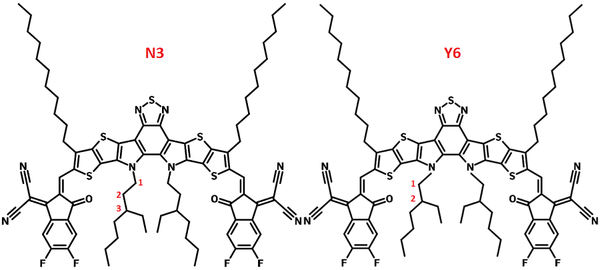 The difference between N3 and Y6 in chemical structure
N3 has a clear solid-state aggregation transition at 82 °C. The shifting of the branching position of the alkyl chains increases the solubility of the molecule significantly from 40 mg/mL for Y6 to 64 mg/mL for N3 in chloroform.
Optimized photovoltaic devices using a binary acceptor system with N3:PC71BM as the acceptors and PBDB-T-2F (PM6) as the polymer donor shows efficient device performance with power conversion efficiencies (PCEs) of up to 16.74% (device 1), and 18.69% while D18-Cl:N3:PC61BM (1:1.4:0.1) is used as the active layer materials (device 2).
Device structure 1: ITO/PEDOT:PSS/PM6:N3:PC71BM/PNDIT-F3N/Ag.
|
Thickness (nm)
|
VOC (V)
|
JSC (mA cm-2)
|
FF (%)
|
PCE (%)
|
|
110
|
0.850
|
25.71
|
76.6
|
16.74
|
Device structure 2: ITO/PEDOT:PSS/D18-Cl:N3:PC61BM (1:1.4:0.1)/PDIN/Ag.
|
Thickness (nm)
|
VOC (V)
|
JSC (mA cm-2)
|
FF (%)
|
PCE (%)
|
|
114
|
0.849
|
28.22
|
78.0
|
18.69
|