Poly(9,9-di-n-octylfluorenyl-2,7-diyl), known as F8 or PFO, is a polyfluorene specifically optimized for a variety of organic electronic applications.
For a high-efficiency green OLED we recommend blending F8 with F8BT with the below specifications. This ink can then be applied either in air, or in a glove box, with little difference in performance (provided exposure time and light levels are minimized).
At typical concentrations of 10 mg/ml, 100 mg of F8 (PFO) will make around 200 devices on Ossila's standard ITO substrates (20 x 15 mm), assuming 50% solution usage (50% loss in filtering and preparation).
Luminosyn™ PFO (F8)
Luminosyn™ PFO (F8) is now available.
High Purity
Purified by Soxhlet extraction with methanol, hexane, and chlorobenzene under an argon atmosphere
Batch-Specific GPC data
Precise molecular weights are always available to provide a reliable reference in your thesis or publication
Large Quantity Orders
Plan and conduct your experiments
with confidence using polymers from the same batch
General Information
|
CAS Number
|
19456-48-5
|
|
Chemical Formula
|
(C29H41)n
|
|
Full Name
|
Poly(9,9-di-n-octylfluorenyl-2,7-diyl)
|
|
Soluble in
|
o-xylene, toluene, chlorobenzene
|
|
Processing Solvents at 10mg/ml
|
o-xylene (8mg/ml), toluene (8mg/ml)
|
|
Synonyms
|
F8, PFO
|
|
Classification / Family
|
Polyfluorenes, Benzothiodiazoles, Organic semiconducting materials, Semiconducting polymers, OLED green emitter materials, OLED materials, Organic photovoltaic (OPV) materials, Polymer solar cells, OFET materials
|
Chemical Structure
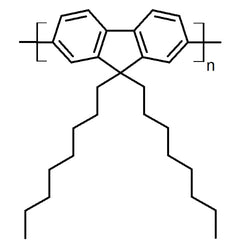 Chemical structure of PFO (F8), CAS No. 19456-48-5
Characterization
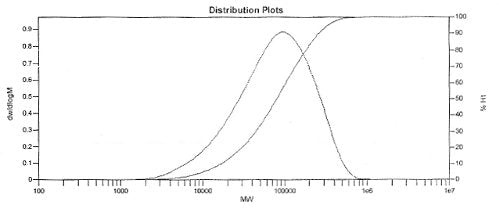 F8 distribution plot
Typical Device Architectures and Performance
A basic, efficient OLED can be made using PEDOT:PSS as a hole-transport layer and Calcium/Aluminum as the electron contact. When used with the Ossila ITO glass OLED substrates and shadow masks this produces an easy to fabricate yet efficient >100 cd/m2 device.
 Typical Ossila device architecture: Polyfluorene-based OLED architecture based on F8 blended with F8BT.
OLED reference device:
-
F8 with F8BT
-
Blend ratio of 19:1 (F8:F8BT) in Toluene
-
Total concentration of 10 mg/ml
-
0.45 μm PTFE filter (hydrophobic)
-
Spun at 2000 rpm (approx. 70 nm thickness)
Pipetting 20 μl of the above solutions onto a substrate spinning at 2000 rpm should provide a good even coverage, with approximately 70 nm thickness. The substrate needs to be spun until dry, which is typically only a few seconds — 15 seconds should be ample to achieve this. Thermal annealing should be undertaken at 80°C for 10 minutes prior to cathode deposition.